Packaging is the cheapest tool a buyer has for protecting six months of work on the farm. It is also the part of the spec sheet most often left to the supplier. Here are the three materials you'll be offered, what each is good for, and what to actually write in the spec.
Foil-laminated pouches and liners
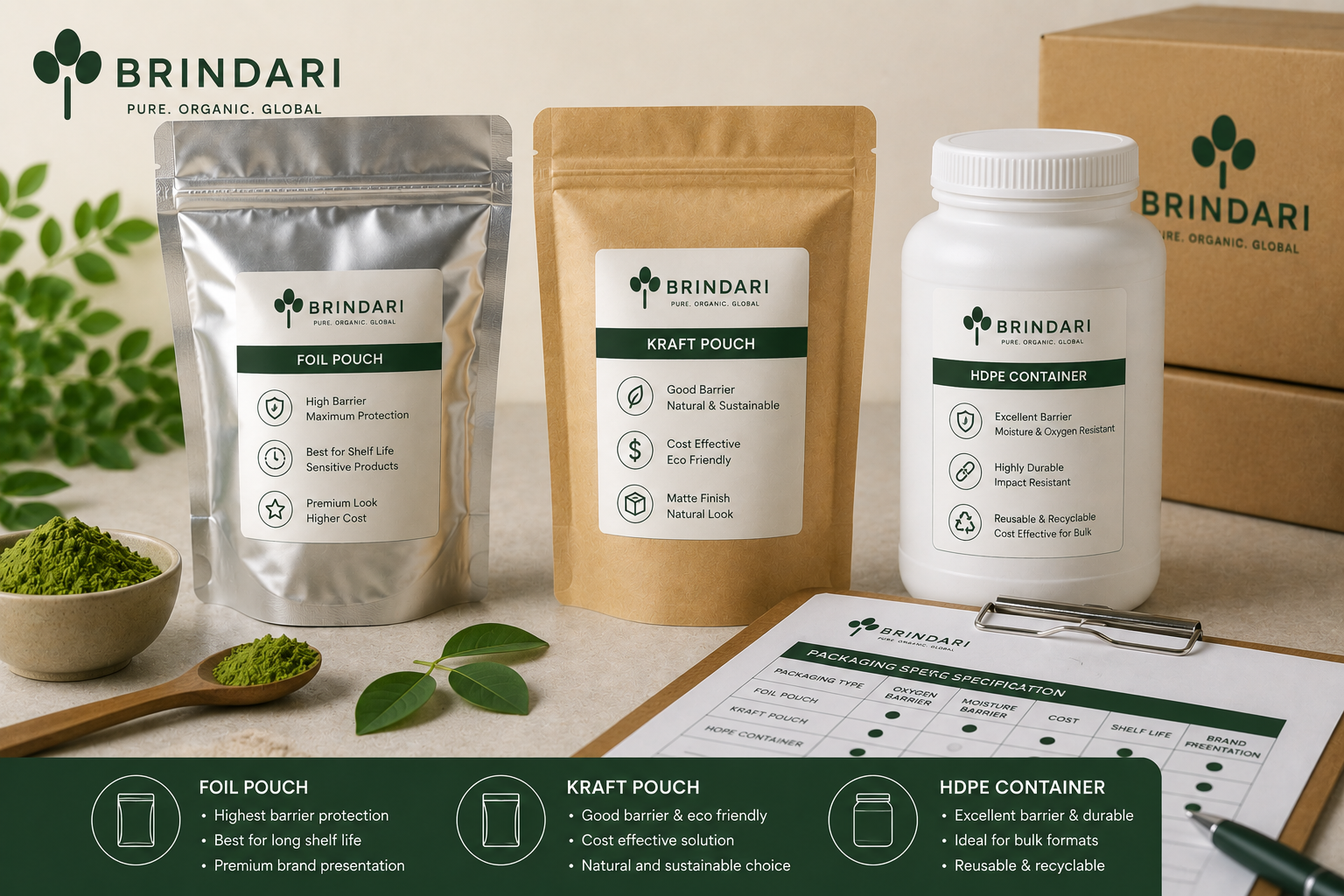
An aluminium foil laminate (typically PET/Al/LDPE, 12 µm + 9 µm + 80 µm) is the highest oxygen barrier you can practically buy. OTR (oxygen transmission rate) drops to under 0.5 cc/m²/day at standard conditions, which means a sealed lot of moringa powder can hold its chlorophyll and vitamin C for 24 months at ambient storage without serious degradation.
Use it for: retail pouches where shelf life matters, inner liners on 20 kg cartons destined for long sea freight, and any moringa lot heading into a hot or humid climate.
Trade-off: cost. Foil pouches run roughly 3–4× the per-unit cost of kraft, and they are not recyclable in most municipal streams. They will also draw a sustainability question from your retail buyer. Be ready to defend it.
Kraft paper with PLA or PE liner
Kraft has become the default "premium natural" look for the wellness shelf — uncoated brown paper outer, with a thin plastic liner inside doing the actual barrier work. The barrier is moderate (OTR around 8–25 cc/m²/day depending on liner) and the shelf life claim should not exceed 12 months unless paired with secondary packaging.
Use it for: retail pouches where brand presentation matters more than two-year shelf life, and any product turning inventory fast.
Trade-off: the liner. A PLA-lined kraft pouch is compostable in industrial facilities; a PE-lined one is not. If your packaging brief says "fully compostable" and the back panel says "PE/Kraft laminate," your sustainability claim is unsupported.
HDPE drums and bag-in-box
For bulk B2B — 25 kg sacks, 200 kg fibre drums, IBC totes — high-density polyethylene with a food-grade inner liner is the workhorse. It is cheap, mechanically robust, stackable to two pallets high, and inert against most food matrices. A typical bulk drum spec uses a 6-mil HDPE inner bag and a fibreboard drum outer, both food-grade.
Use it for: any bulk shipment going into a buyer's own packaging line. There is no reason to pay for retail-grade material on goods that will be repacked within 30 days of arrival.
What to actually write in the spec
"Premium foil pouch" is not a spec. Try this instead:
- Primary pack: 250 g retail pouch, PET 12 µm / Al 9 µm / LDPE 80 µm laminate, matt-print, zipper closure, tin-tie. OTR ≤ 1.0 cc/m²/day.
- Inner liner: food-grade LDPE 80 µm, nitrogen flushed, heat-sealed.
- Master carton: 12-pouch double-wall corrugated box, 5-ply, BCT ≥ 35 kgf, ECT ≥ 32.
- Pallet: heat-treated wood (ISPM-15), 1.0 × 1.2 m, stretch-wrapped with edge boards.
If your supplier can't quote against this, they are either guessing or buying packaging in the open market each shipment. Either way, you'd want to know.
The unglamorous one: nitrogen flush
For retail powders specifically, ask whether the inner liner is nitrogen-flushed. A simple N₂ purge before heat-seal drops residual oxygen from ~21% to ~2%, which extends the colour-stable shelf life by 4–8 months on the same packaging. It costs roughly $0.03–0.05 per pouch at retail-pouch scale. Some suppliers do it by default; many don't — it's worth asking about and writing into the spec.
Packaging is a small line on the budget. It is a big lever on what arrives at the consumer's hand still looking like moringa.