When a formulator asks for "100 mesh" moringa, they are quietly telling you four things about their product: how it will feel in the mouth, how evenly it will disperse, how cleanly it will fill a capsule, and how stable the colour will be on a shelf. Here is the field guide.
What "mesh" actually means
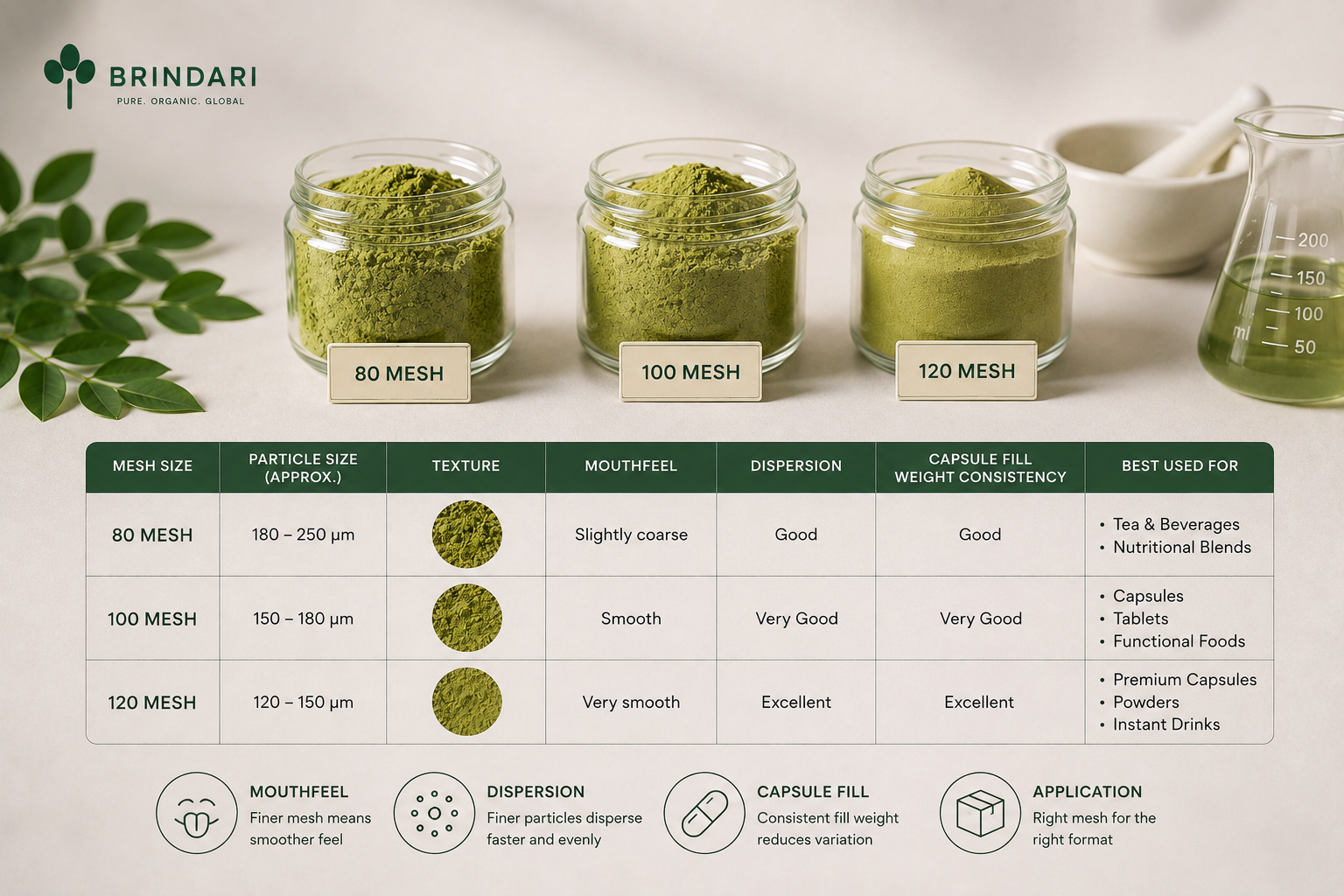
Mesh number is the count of openings per linear inch in a standard sieve. A 100-mesh sieve has 100 openings per inch — so a higher number means a finer screen and finer particles. A few rough equivalents, because this trips up new buyers:
| Mesh | Opening (µm) | Feels like | Typical use |
|---|---|---|---|
| 40 mesh | ~420 µm | Coarse, sandy | Tea cuts, tincture extraction |
| 60 mesh | ~250 µm | Coffee-grind | Tea bags, granola, bakery |
| 80 mesh | ~177 µm | Fine flour | Mid-range supplements, smoothie mixes |
| 100 mesh | ~149 µm | Talc-like to touch | Premium powders, capsules, beverages |
| 120 mesh | ~125 µm | Silky, dusty | Cosmetics, masks, high-end beverages |
| 200 mesh | ~74 µm | Pharma-fine, floats | Niche cosmetic, micro-encapsulation |
Most moringa powder sold globally is 80 to 100 mesh. Anything coarser, and you start to see and chew the particles. Anything finer than 120 and you are paying for milling time the consumer can't taste.
What changes when you go from 80 to 100 mesh
People assume the difference between 80 and 100 mesh is cosmetic. It isn't. Here is what changes in the formulation, with rough industry numbers reported from blend and dispersion trials.
Mouthfeel and dispersion
At 80 mesh, a teaspoon stirred into 200 ml of water at room temperature will sediment about 35% of solids in 30 seconds. At 100 mesh, sedimentation drops to about 18%. At 120 mesh it's under 10%. For a powder drink mix, the difference is the gap between a customer saying "tastes good" and "tastes good but I keep stirring it." That difference is mesh, not flavour.
Capsule fill weight
A 0 capsule body holds nominally 400 mg of moringa at 80 mesh and around 500 mg at 100 mesh — because finer powder packs more densely. Move to 120 mesh and you can hit 540 mg in the same shell. Your formulator may quietly drop a size — from size 00 to size 0 — and recover ~$0.012 per capsule on encapsulation costs. On 5 million capsules a year, that is real money.
Bioavailability — the honest version
Particle size affects dissolution rate, which affects how quickly the actives become available in the gut. For moringa specifically, in-vitro work suggests that going from 80 to 100 mesh increases polyphenol release in simulated gastric fluid by roughly 18–25% over a 30-minute window. Whether this translates to a perceptible benefit for the consumer is uncertain. We would not put it on a label.
Why your formulator cares more than your marketing team
The marketing team is looking at the front of pack. They want "Premium Organic Moringa Leaf Powder" and a green colour that photographs well. They don't care about mesh.
The formulator is the one staring at a stability report. They care because:
- A coarser powder separates and settles in a wet matrix. They will reformulate around a finer mesh to avoid texture complaints in months 3–6 of shelf life.
- A finer powder has more surface area, which means more contact with oxygen and faster oxidation of the chlorophyll. They will spec a tighter packaging barrier to compensate.
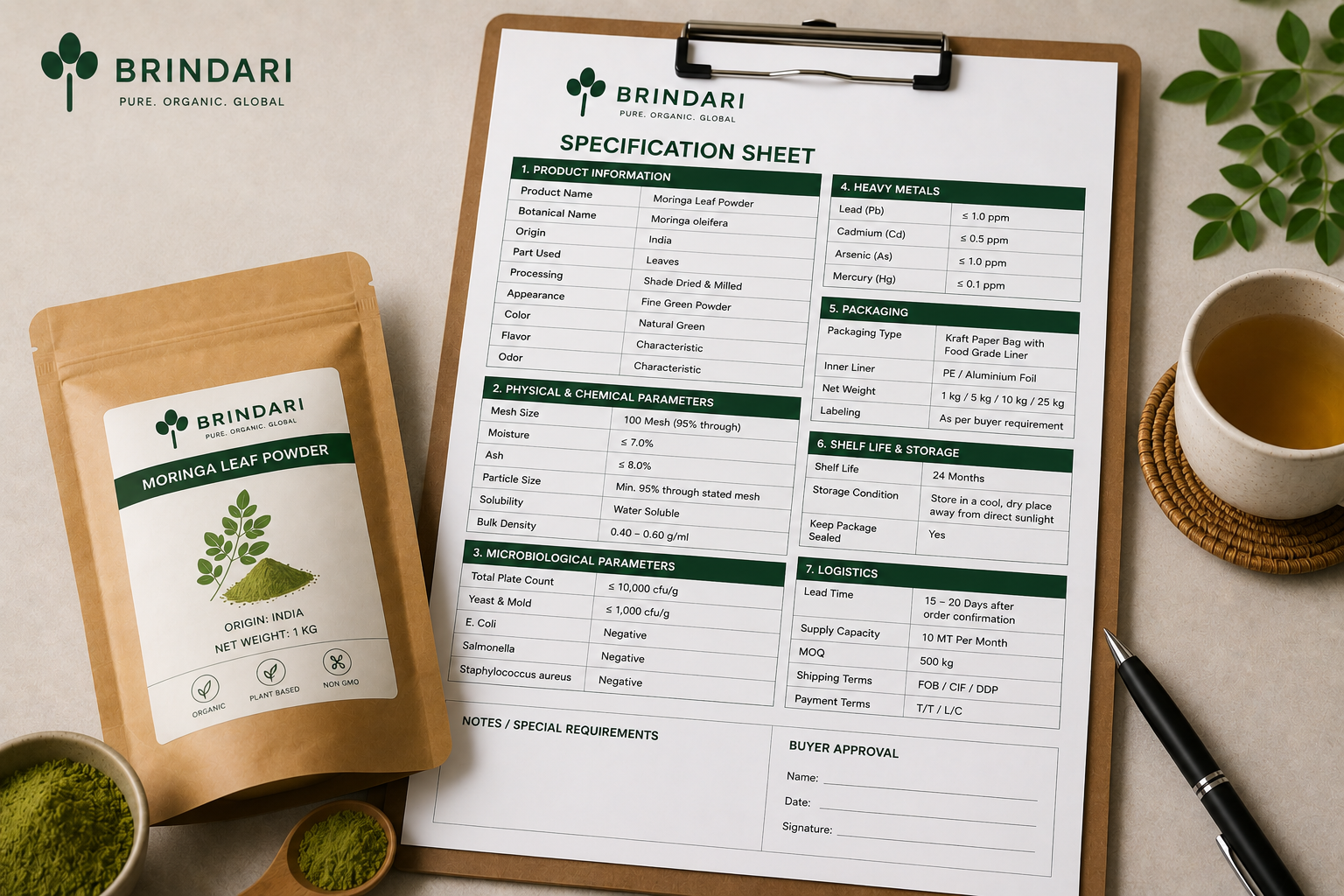
- A spec that says "80–100 mesh" with no further definition opens a moving target every shipment. They want a tighter window: ≥ 95% through 100 mesh, ≤ 5% retained on a 60-mesh sieve.
How mesh QC is typically run
Reputable processors run a particle-size check on every lot before bagging: a 25-gram sample through a stack of sieves (40, 60, 80, 100, 120 mesh) on a vibratory shaker for 10 minutes, with the weight retained on each step recorded. The resulting PSD (particle size distribution) curve should appear on the COA. Lots outside the target window are re-milled or re-sieved before packing. A buyer can ask to see a recent sieve report on standard letterhead — a supplier with a real QC routine will not hesitate.
What to write on the spec sheet
Don't write "100 mesh." That is ambiguous. Write something like:
Particle size distribution: ≥ 95% pass through 100 mesh (149 µm); ≤ 2% retained on 60 mesh (250 µm); no visible fibrous matter or stem fragments.
This is a target you can hit, audit, and reject against. "100 mesh" is a wish.
If you only remember one thing
Mesh is not just texture. It is the single most consequential parameter on the spec sheet after moisture, microbial load, and heavy metals. Ask your supplier what mill they use, what their PSD curve looks like on a typical lot, and whether they can hold a tighter window than the marketing one-pager claims. The good ones will email you a sieve report by the end of the day.