A surprising share of moringa RFQs land on a supplier's desk unquotable. Not because the buyer is unserious, but because the spec sheet is missing the two or three numbers a supplier needs to put a real price on the page. This is the spec template the industry wishes more buyers used.
Why a tight spec is in the buyer's interest
A loose spec — "premium moringa leaf powder, organic, food-grade" — lets every supplier deliver to the lowest version of the description that is still defensibly compliant. The cheapest powder that can legally be called "premium" is what fills the quote, and the buyer spends two weeks of email exchange trying to find out why it doesn't match the sample.
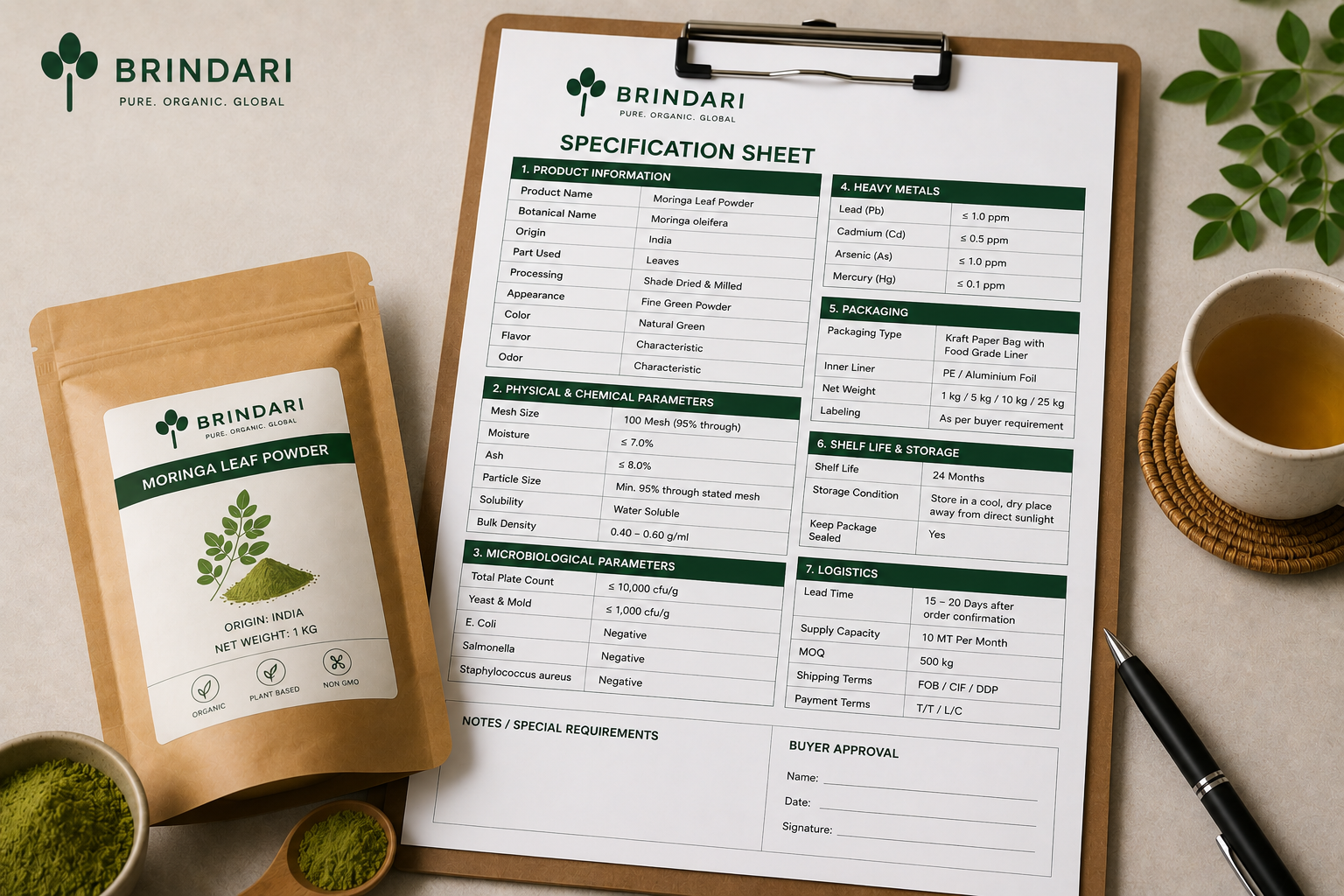
A tight spec — moisture, mesh, microbial limits, heavy metals, packaging, labelling, lead time — gives every supplier the same target. The quotes become directly comparable. The cheapest one is now actually the cheapest, not just the loosest-spec one. And when the goods arrive, the buyer has a document to reject against.
The two-page spec, section by section
1 · Product identity
- Botanical name: Moringa oleifera Lam., leaf only.
- Common name: Moringa leaf powder.
- Variety / cultivar: e.g. PKM-1, ODC-3 — or "supplier's standard" if you don't care.
- Origin: country (and, if it matters for traceability, sub-region) — or "supplier's standard origin" if the buyer is indifferent.
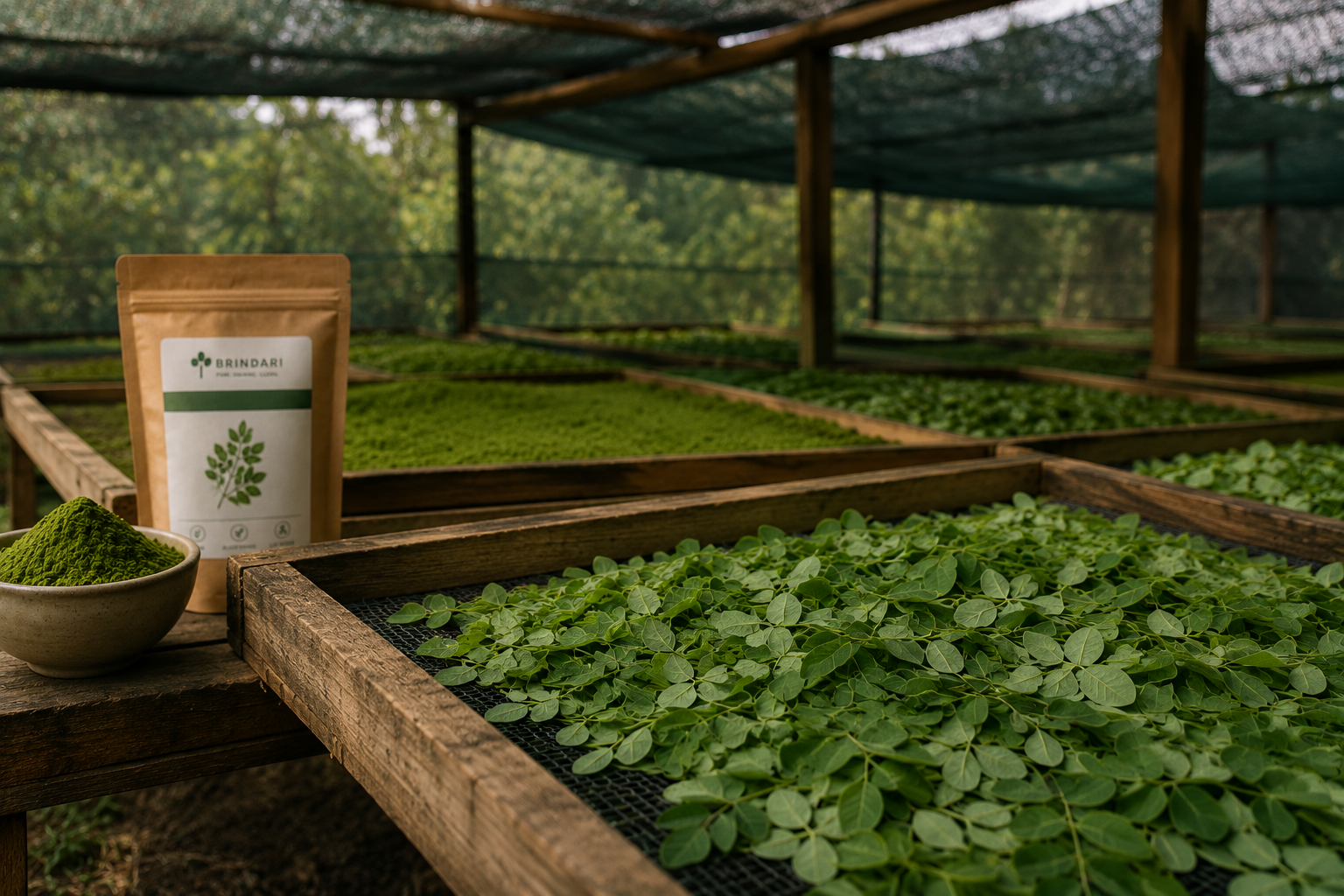
- Manufacturing process: shade-dried; mechanically milled; sieved. (You'd be surprised how often this isn't stated.)
- Certification claims: USDA NOP organic, EU 2018/848, JAS, kosher, halal — list each, with certifier name.
2 · Sensory specification
- Colour: bright forest green; no greying, yellowing, or browning.
- Aroma: characteristic of moringa leaf; mildly grassy, no rancid, mouldy, or fermented notes.
- Taste: characteristic of moringa leaf; clean, mildly bitter; no off-notes.
- Texture: fine free-flowing powder; no lumps, fibrous matter, or stem fragments visible to the naked eye.
3 · Physical specification
- Moisture: ≤ 8.0% (target 6.0–7.5%).
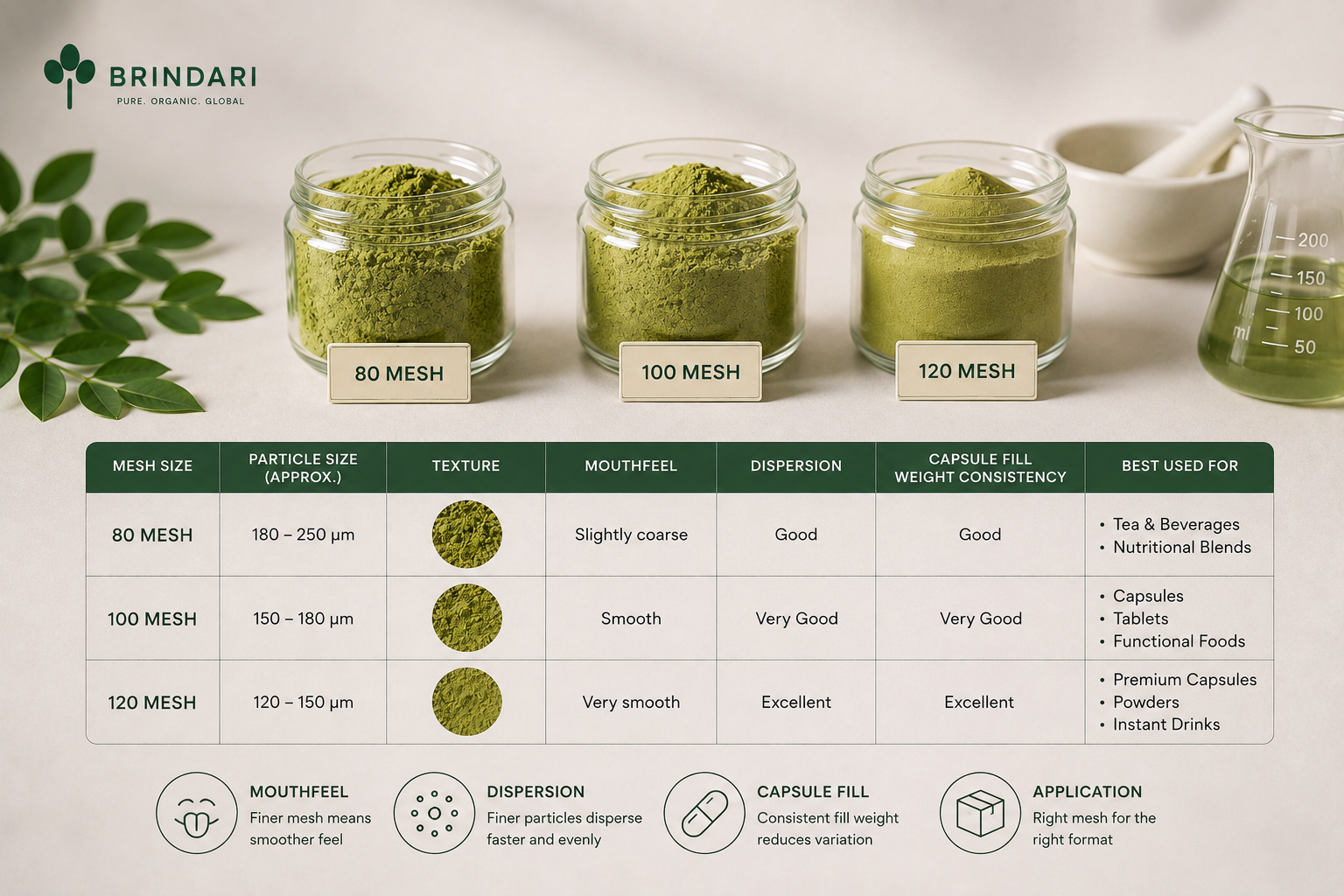
- Particle size: ≥ 95% pass through 100 mesh (149 µm); ≤ 2% retained on 60 mesh.
- Bulk density: 0.42–0.50 g/mL (relevant if you are filling capsules or sachets).
- Total ash: ≤ 11%. Acid-insoluble ash: ≤ 1.5%.
4 · Microbiological specification
- Total Plate Count: ≤ 50,000 CFU/g (≤ 10,000 if for beverage / direct-consumption application).
- Yeasts & Moulds: ≤ 1,000 CFU/g.
- Coliforms: ≤ 10 CFU/g. E. coli: absent in 1 g. Salmonella: absent in 25 g. S. aureus: ≤ 100 CFU/g.
- State explicitly whether ETO fumigation is permitted (most EU/US markets: no), and whether steam sterilisation is acceptable (varies; ask).
5 · Chemical & contaminant specification
- Heavy metals: Pb ≤ 1.0 ppm, As ≤ 1.0 ppm, Cd ≤ 0.5 ppm, Hg ≤ 0.1 ppm.
- Pesticide residues: ND on a full multi-residue panel (LC-MS/MS + GC-MS/MS, ~250 analytes) at lab LOQ; or, at minimum, compliant with the destination market's MRLs (EU Reg. 396/2005, or 21 CFR 180 for the US).
- Mycotoxins: total aflatoxins ≤ 4 µg/kg (EU); B1 ≤ 2 µg/kg. Ochratoxin A ≤ 10 µg/kg.
- Allergens: state whether the facility handles any of the 14 EU regulated allergens. If yes, state cross-contact controls.
6 · Active / marker compounds
If your product makes any composition claim — "high in vitamin C," "rich in iron" — write the floor here:
- Chlorophyll (total): ≥ 5.0 mg/g (good shade-dried lots run 6–8 mg/g).
- Vitamin C: ≥ 150 mg/100g.
- Crude protein: ≥ 24% w/w.
- Iron: ≥ 25 mg/100g.
Important: these are minima, and lab-to-lab variance on natural products is real. Set the floor 10–15% below your label claim, not at it.
7 · Packaging
The most-skipped section, and the one that costs the most to fix later.
- Primary pack: format, material, weight, closure. (See our packaging note for the full template.)
- Inner liner: material, thickness, sealing method, N₂ flush yes/no.
- Master carton: dimensions, ply, BCT/ECT, units per carton, gross weight.
- Pallet: dimensions, wood (ISPM-15), max cartons per pallet, stretch-wrap yes/no, edge boards yes/no.
- Labelling on primary pack: list every element (brand, product name, weight, lot code, MFG date, BBE date, COO, ingredients, allergens, nutrition panel format, certifications). If you have artwork, attach a PDF.
- Carton labelling: lot code format, GS1 barcode yes/no, customer PO reference yes/no.
8 · Lead time, MOQ, and lot-tracking
- Minimum order quantity: state per SKU.
- Lead time: signed PO to FOB origin port (typical for moringa powder: 4–6 weeks for first shipments; 2–3 weeks for repeat orders against open inventory).
- Shelf life: 18 or 24 months, stated condition (e.g. "stored ≤ 25°C, ≤ 60% RH, in unopened original packaging").
- Lot definition and traceability: every shipment one continuous lot or multiple? Lot code format to be on COA and pack.
9 · Documentation
List every document you expect with the shipment:
- Commercial Invoice and Packing List.
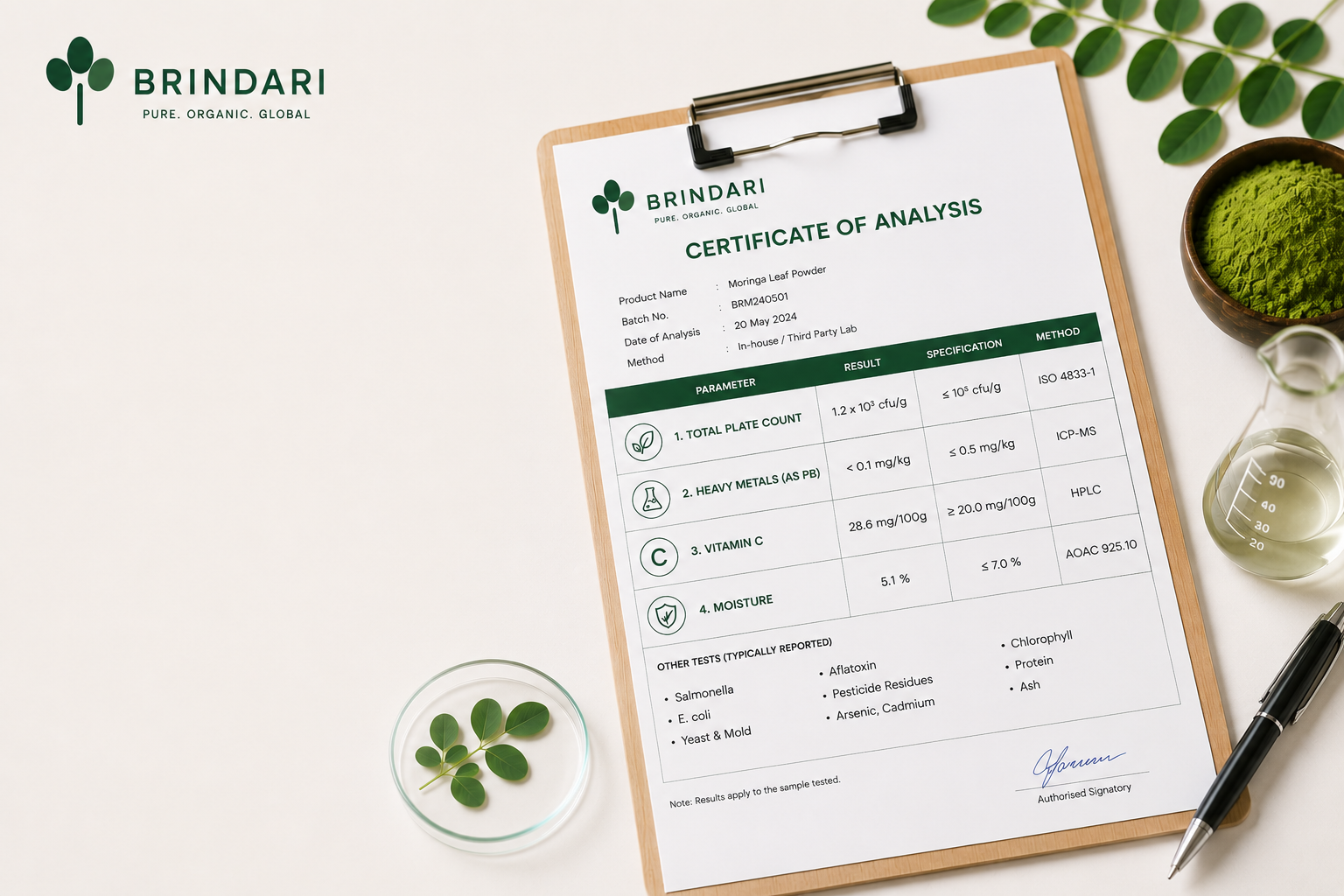
- Certificate of Analysis from accredited lab, lot-specific.
- Phytosanitary certificate (origin country).
- Certificate of Origin (chamber-stamped if your duty preference needs it).
- Organic transaction certificate (NOP / EU / both), if applicable.
- Bill of Lading (telex-released or original, state preference).
- ISPM-15 wood treatment certificate (or fumigation certificate, if applicable).
10 · Quality release procedure
State what happens if a parameter is out of spec. Most templates skip this and discover the answer the painful way.
- Right to retain sample: 250 g of every lot, held for 24 months.
- Right to independent re-test: at buyer's cost; supplier honours result from any ISO 17025 lab.
- Disposition of out-of-spec lot: re-work, replacement, refund, or discount — agreed before shipment leaves origin.
What this looks like, signed
A good spec sheet runs about two pages, signed at the bottom by both the supplier's quality manager and the buyer's procurement lead, with a version number. It becomes part of the master purchase agreement and is referenced on every PO. When a parameter changes — a new mesh, a different pouch, an added certification — reissue the spec sheet, not the email thread.
A blank moringa spec template is available on request — write to hello@brindari.com for a copy. Use it with whichever supplier suits the brief. Tighter specs are good for the industry: they make the market easier for serious buyers and serious suppliers to find each other.