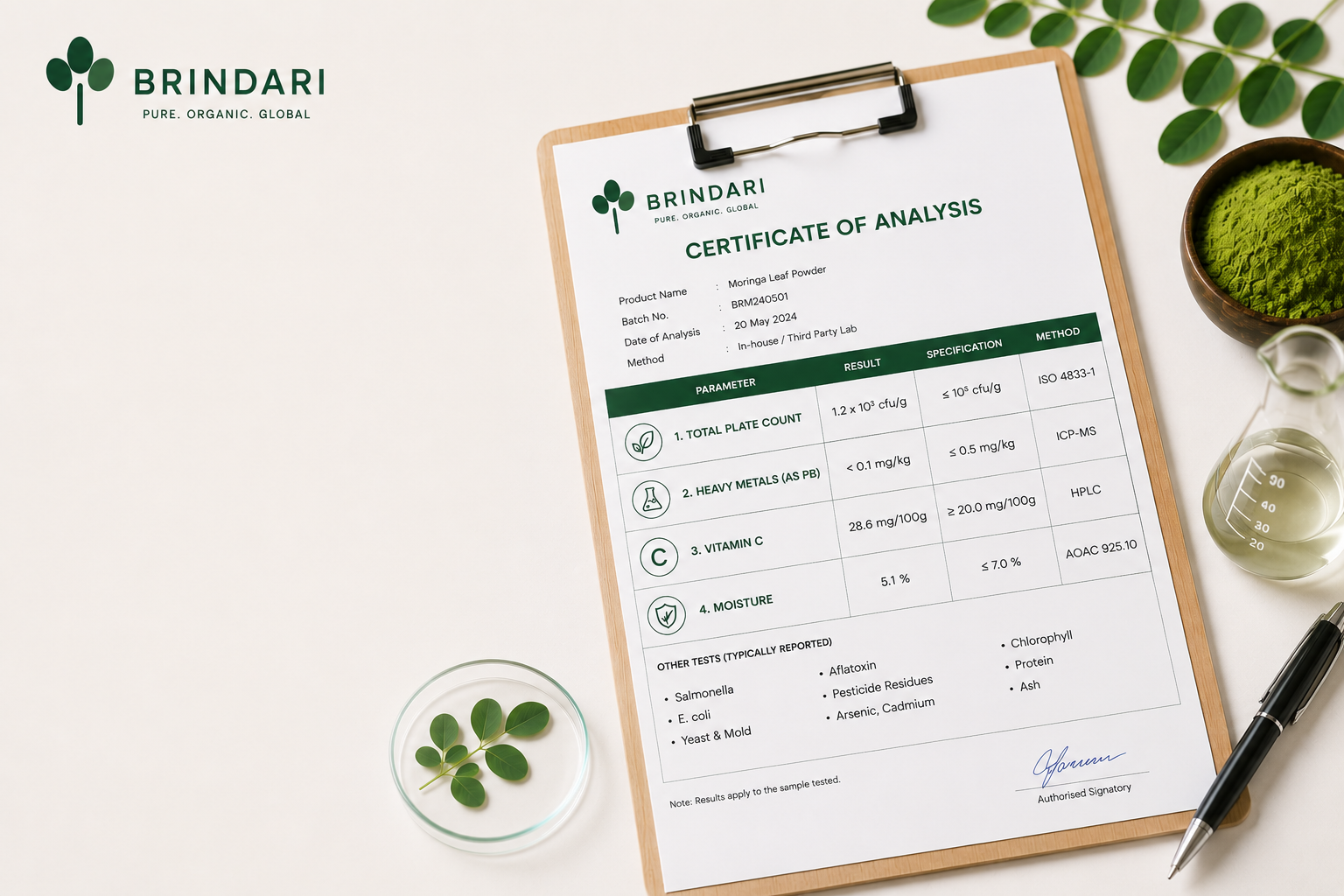
A COA — Certificate of Analysis — is the single most important piece of paper that ships with every lot of moringa. Most buyers do not know how to read one. Here is what to ask about first.
What a COA is, and what it is not
A COA is a snapshot, taken by an accredited lab, of a specific lot of product at a specific moment. It tells you what the powder in that bag tested at, on that day. It is not a guarantee about the next bag. It is not a substitute for an audit of the facility. And it is not — though buyers often treat it this way — a measure of how trustworthy the supplier is.
A clean COA from a good lab can come from a bad supplier who cherry-picked the sample. A messy COA from a great supplier can mean the bag was honestly tested under post-monsoon conditions and the supplier didn't massage the result. Read the document, then read the person who sent it.
The four numbers that actually matter
If you only look at four lines on a moringa leaf-powder COA, look at these.
1 · Moisture
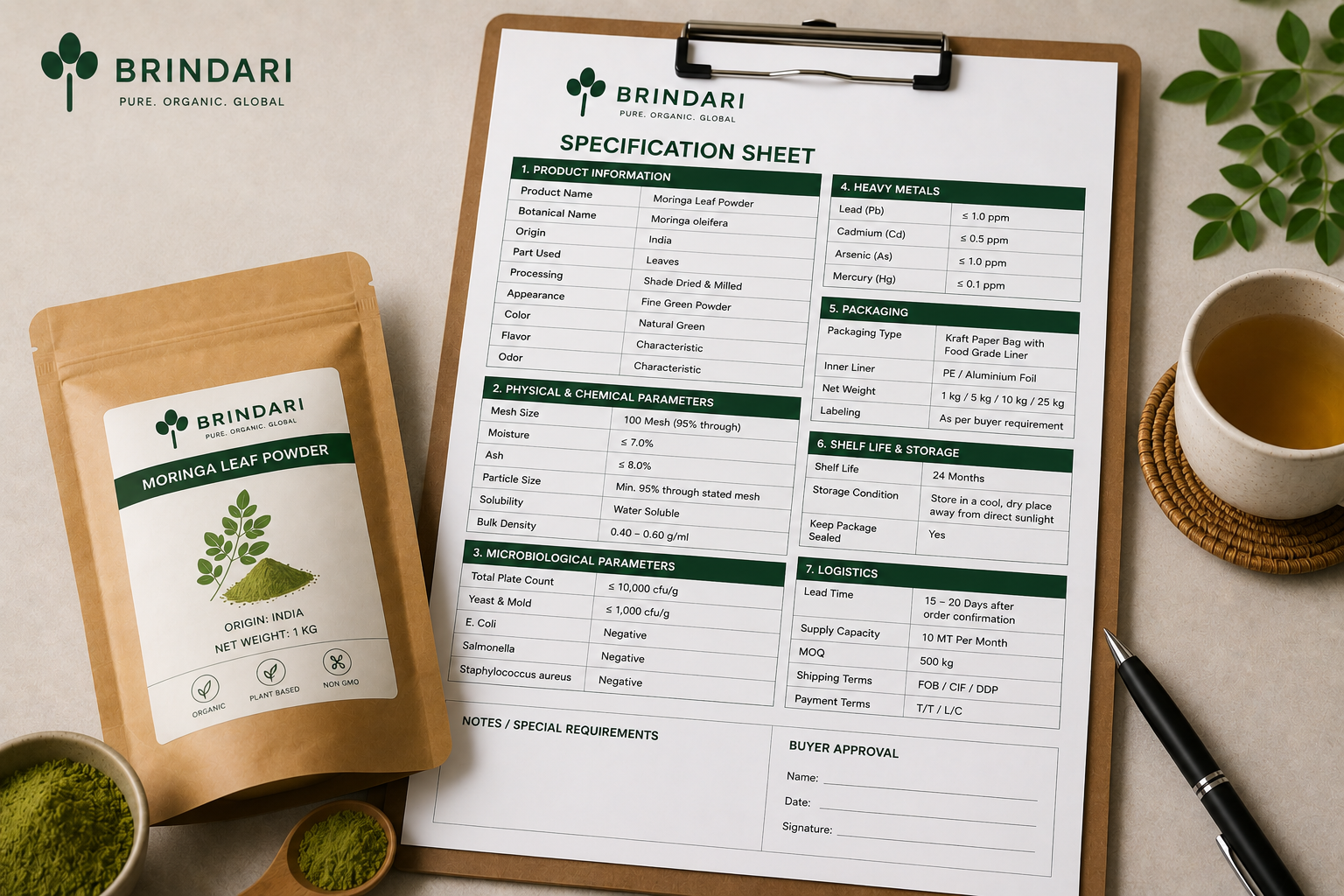
Target: ≤ 8.0%. Above 10% and the powder is a microbial risk in transit. Above 12% and it will cake. Below 4% and someone over-dried it and you have lost colour and aroma. The sweet spot is 6–8%.
2 · Total Plate Count (TPC) and yeast/mould
Target: TPC ≤ 50,000 CFU/g, Y&M ≤ 1,000 CFU/g. If you are formulating into a beverage or supplement, ask for ≤ 10,000 TPC. Anything above 100,000 is non-food-grade by EU standards; do not negotiate.
3 · Heavy metals — lead and arsenic in particular
Target: Pb < 1.0 ppm, As < 1.0 ppm, Cd < 0.5 ppm, Hg < 0.1 ppm. Moringa is a bioaccumulator. A lot grown next to a busy road or downstream of a tannery will fail these limits even if everything else looks pristine. This is where origin matters more than process.
4 · Pesticide residue (or, ideally, "ND" across a multi-residue panel)
If you are buying certified organic, you want a full multi-residue panel — LC-MS/MS and GC-MS/MS, ~250 analytes — showing ND (not detected) at the LOQ of the lab. A "compliant with EU MRL" stamp without the underlying panel is not enough.
Numbers that look impressive but mostly aren't
You will see suppliers leading with antioxidant capacity (ORAC), total phenolics (TPC), or "vitamin C: 220 mg/100g" on the front of a marketing one-pager. Two things to know.
ORAC is not a regulated metric. Antioxidant capacity scores look impressive on a slide but they do not predict how a compound actually behaves in the body, which is why most regulators stopped treating them as a meaningful quality signal years ago. A high ORAC number on a COA is a marketing flourish, not a quality decision.
Vitamin C in dried moringa is highly variable. Anything above 200 mg/100g is unusual; values of 600+ are almost always either fresh-leaf measurements re-stated or wishful thinking. Treat extreme numbers as a reason to ask for a re-test, not as a selling point.
Lab matters more than the cover page
A COA from an accredited lab — NABL in India, ISO/IEC 17025 internationally — is worth ten times one from an unaccredited in-house lab. Ask for the accreditation number on the report. If the supplier hesitates, that is the answer.
Reputable suppliers will use a recognised third-party lab — SGS, Eurofins, Intertek, or a NABL/ISO 17025-accredited regional lab — for export-grade lots, with an in-house lab only for routine in-line QC. Both accreditation numbers should appear on every COA the supplier issues.
One last thing: ask for the sample, not just the report
Any supplier can send a clean COA. Far fewer will also send the retained sample the COA was drawn from, so a buyer's own lab can cross-check it. Industry good practice is to hold a 250-gram retained sample of every lot for 18–24 months and to ship it on request. Suppliers that won't release a retain sample are worth a follow-up question.
A COA is a tool. Like all tools, it works best in the hands of someone who knows what they are looking at. Skim the four lines above first. Everything else is detail.