Every monsoon, the same question lands in a buyer's inbox: why does the shade-dried quote take a week longer than the sun-dried one? The answer fits on one line — the drying method — but the trade-off is worth the long version. Here it is, with the typical industry numbers.
The temptation of sun-drying
On a clear day in the tropics, the temperature on a black drying tarp can hit 60–65°C by late morning. A typical 200 kg batch of fresh moringa leaf, harvested at dawn and spread flat in the sun, can lose enough moisture to be millable by the following sundown. Twenty-six to thirty hours, end to end.
Shade drying takes 70 to 80 hours for the same batch in dry weather. In humid post-monsoon months, when ambient humidity sits north of 75%, it can stretch to four full days. From the buyer's calendar, that's a week of lead time the sun-dryer down the road simply doesn't have.
If a supplier is optimising for throughput, the decision is obvious. If they are optimising for retained colour and assay, it isn't.
What the sun actually does
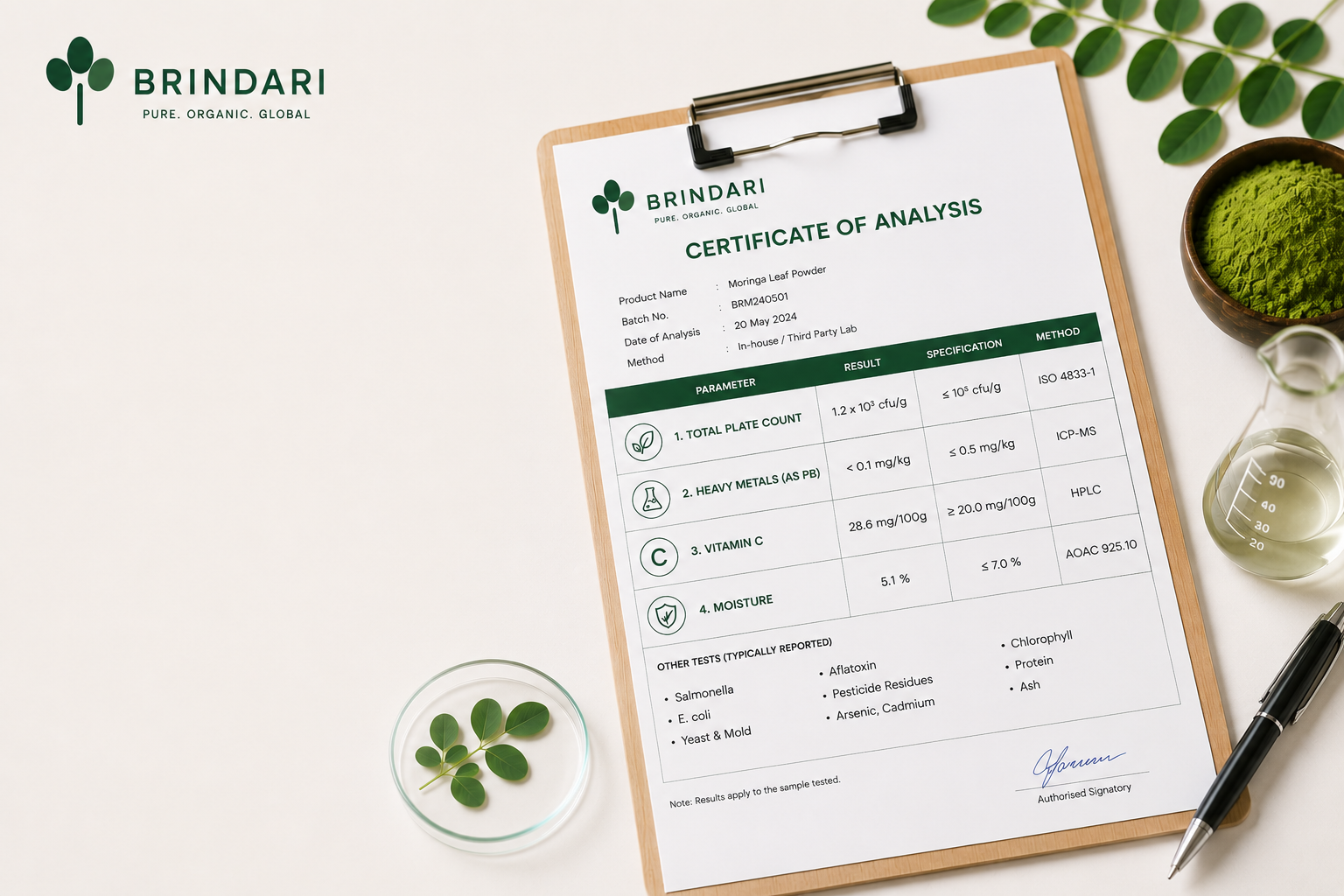
Moringa's commercial value is wrapped up in three fragile compounds: chlorophyll (the green colour), vitamin C, and a class of polyphenols including quercetin and chlorogenic acid. All three are heat-labile. All three are also photosensitive — they degrade under direct UV.
The exact numbers move around lot to lot, but the direction is consistent and well documented in food-science literature on leafy-green drying. Open sun-drying typically strips 40–60% of chlorophyll and 50–70% of vitamin C within the first 24 hours. Shade drying at ambient temperatures (28–35°C is a common working range) loses roughly 10–18% of chlorophyll and 20–30% of vitamin C over the longer drying window. The same leaf, two different methods, two completely different finished products.
What the typical numbers look like
Published studies and industry COA data converge on roughly the same picture. The figures below are typical ranges seen across reputable moringa producers using each method on the same cultivar (commonly PKM-1) and harvest window. Treat them as industry benchmarks, not single-lot results.
| Method | Drying time | Chlorophyll (mg/g) | Vit. C (mg/100g) | Typical colour |
|---|---|---|---|---|
| Open sun | 24–30 h | 1.5–2.5 | 50–85 | Olive to olive-brown |
| Solar tunnel (covered) | 30–40 h | 3.5–5.0 | 110–150 | Olive-green |
| Shade (ambient) | 70–80 h | 6.0–8.0 | 150–200 | Forest green |
| Cabinet / hot-air (40–45°C) | 10–16 h | 5.5–7.5 | 140–190 | Forest green |
Shade-dried lots typically run roughly three times the chlorophyll, and around 2× the vitamin C, of sun-dried lots from the same harvest. The colour difference is more dramatic in person than any photo can communicate — a buyer holding both jars under a desk lamp does not need a lab report to choose.
Why the slower method costs more
So why does anyone sun-dry? Because the economics, on paper, are real. The cost gap between methods has four moving parts, and a buyer evaluating shade-dried quotes should understand each:
- Working capital tied up. An extra 6–7 days of inventory at typical lot values translates into measurable financing cost — a real line item for the supplier.
- Drying yard footprint. Covered shade yards use roughly twice the floor area per kg, because racks are open-sided and spaced to vent humidity rather than sealed under tarps.
- Labour for turning. Shade-dried leaf has to be turned every 8 hours or so to prevent matting and patchy moisture. Sun-dried leaf, dried hotter and faster, needs less attention.
- Risk of weather delay. A rain event during the slow drying window means an extra day of dehumidified-room finishing, which suppliers price in as a contingency.
Aggregated, the cost premium for shade-drying typically runs $0.80–1.20 per kg of finished powder compared to open sun-drying. That is the real number behind the slower lead time — and the reason a serious shade-dried quote will never undercut a sun-dried one on price.
Why brands still pay the premium
Because the customers who care about moringa for what it actually contains — not what they can claim on a label — can tell. Brands building a serious functional foods or nutraceutical product line look at the chlorophyll number and the vitamin-C retention first, before they even open the price column. A jar of sun-dried powder might cost $0.80 a kg less. It will also cost the formulator's confidence and, eventually, a customer complaint about colour drift in batch two.
"The cheapest moringa on the market is also the moringa with the least moringa in it."— common refrain among buyers after their first side-by-side trial
How shade yards typically work
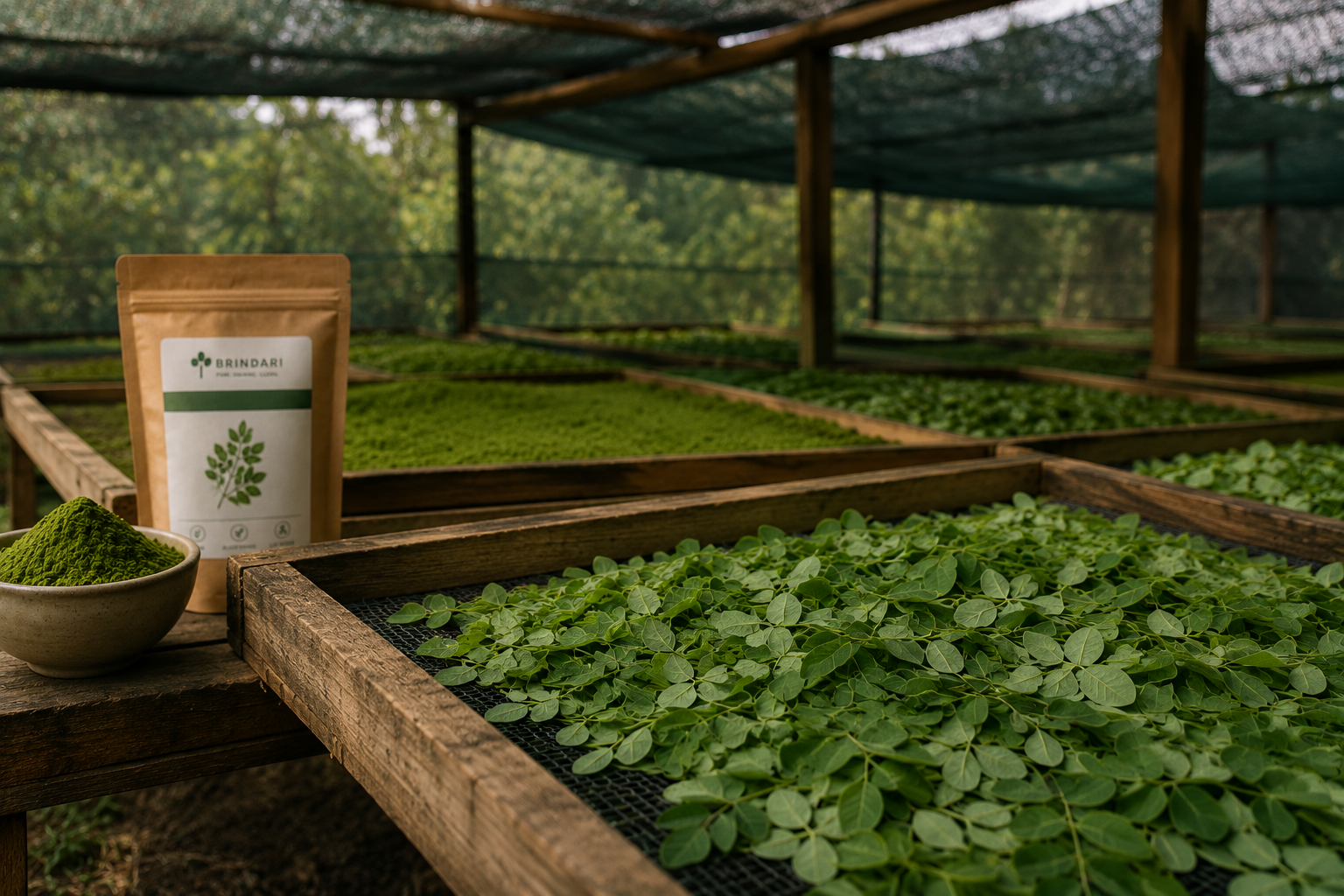
It is less sophisticated than it sounds. A well-run shade-drying setup tends to share a common pattern: open-sided sheds with 70%-shade UV-cut nets overhead, food-grade HDPE mesh racks at waist height, and low-RPM ceiling fans switched on when ambient humidity climbs past 65%. No heat, no forced air, no thermal jacket. Leaves sit on the racks in a layer about 4–5 cm deep and are turned every eight hours with wooden rakes.
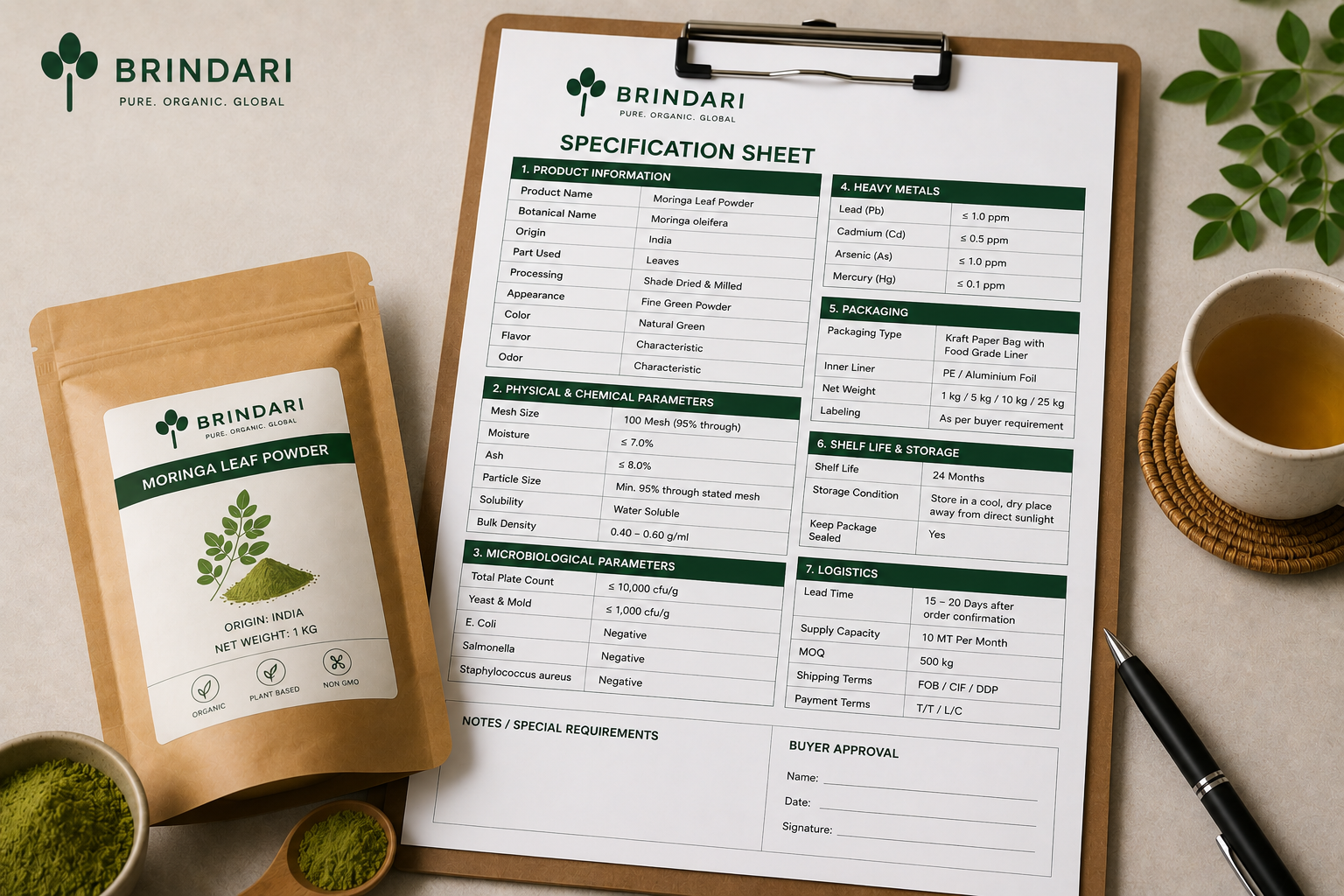
Moisture is typically checked by hand-feel every 12 hours and confirmed with a benchtop NIR meter at the 60-hour mark. The target is 6–8% moisture; the batch is pulled when it lands inside that window and rested for two hours before milling. Variants of this setup exist — some producers use solar tunnels, some add dehumidified finishing rooms — but the core principle is the same: low temperature, no UV, long residence time.
What to ask a supplier choosing between methods
For products where the moringa is decorative — a green dust on a snack bar, a label claim — sun-dried powder is not unsafe. It will just be less green and less potent than the assay implies it should be.
For products where moringa is the active ingredient — a functional beverage, a supplement, a wellness blend where the consumer expects to feel something — a buyer should ask the supplier exactly how the leaf was dried, and see the chlorophyll and vitamin C numbers from an accredited lab, not the cover page of a marketing deck. The difference is measurable. The week is worth it.
The simplest test is a side-by-side sample under daylight. The decision tends to make itself.