"The miracle tree." "More iron than spinach." "More vitamin C than oranges." Moringa marketing has spent a decade making claims that the leaf itself never asked to support. If you are buying it, formulating with it, or selling it, you owe the leaf — and your customer — a more honest reading. Here it is.
The plant, briefly
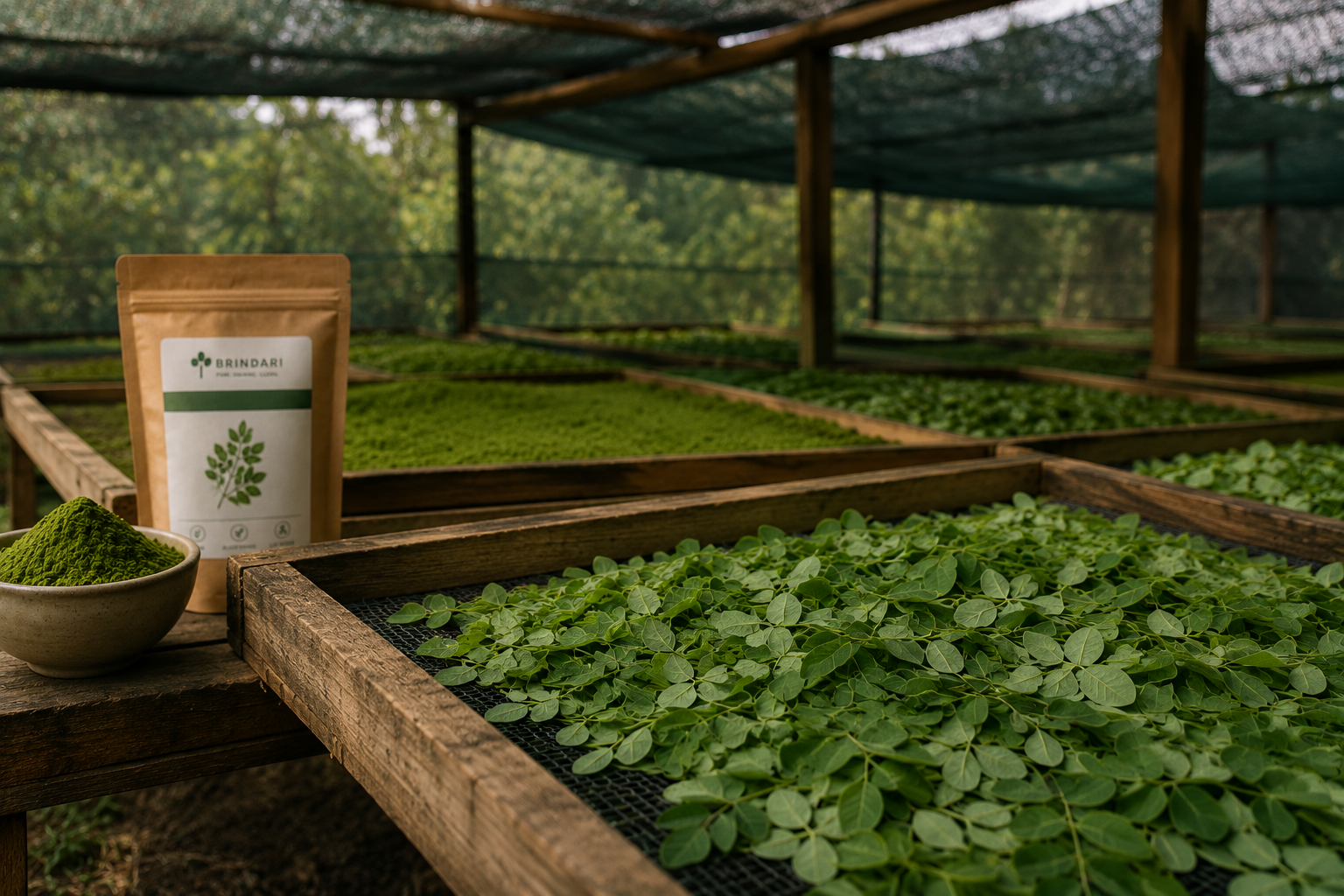
Moringa oleifera is a fast-growing, drought-tolerant tree native to the sub-Himalayan tract of India, now cultivated across the tropics. It is the most studied of the 13 species in the genus Moringa. The leaves, pods (drumsticks), seeds, and roots are all edible in some preparation, but the commercial industry is built almost entirely on the leaf — dried, milled, sometimes extracted.
Botanically: family Moringaceae. Cultivars: PKM-1, PKM-2, ODC-3, Bhagya, and several Indian and African landraces. Yield: a well-managed plantation in southern India can produce 4–6 tonnes of fresh leaf per acre per year, in 6–8 cuttings.
What is in a gram of dried leaf, honestly
The composition varies by cultivar, soil, season, and processing. The numbers below are typical ranges drawn from published moringa composition studies and aggregated industry COA reporting, expressed per 100 g of dried leaf powder:
| Component | Typical range | Reference (per 100g) |
|---|---|---|
| Protein | 22 – 28 g | Cooked beef: ~28 g |
| Iron | 20 – 35 mg | Spinach (raw): 2.7 mg |
| Calcium | 1,800 – 2,200 mg | Milk: ~120 mg |
| Vitamin A (β-carotene) | 15 – 25 mg | Carrot: ~8 mg |
| Vitamin C | 140 – 220 mg | Orange: ~53 mg |
| Potassium | 1,200 – 1,500 mg | Banana: ~358 mg |
| Total polyphenols | 1.5 – 3.5 g | Green tea: ~3 g |
| Chlorophyll | 5 – 9 mg/g | — |
The marketing claims, reviewed
"More iron than spinach"
Yes — on a per-100 g dried basis. Moringa leaf powder has 20–35 mg of iron per 100 g; raw spinach has 2.7. But raw spinach is ~91% water and moringa powder is ~7%. Compare hydrated spinach to dehydrated moringa and you are mostly comparing the absence of water. Compare them at typical serving sizes — a 5 g moringa serving vs. an 85 g spinach serving — and a portion of spinach delivers more iron than a portion of moringa. Both are good iron sources. Neither replaces the other.
Bioavailability matters too. The iron in moringa leaf is non-haem and is bound up with phytates and tannins, which lower absorption. In practice, the absorbable iron from a 5 g moringa serving is in the same ballpark as a small handful of cooked spinach. "More iron than spinach" is technically accurate, practically misleading.
"More vitamin C than oranges"
Same trick. Per 100 g dried, yes. Per realistic serving — and after factoring in the vitamin C lost during drying — no. A typical 5 g serving of moringa powder delivers ~8 mg of vitamin C. A medium orange delivers ~70 mg. Honest framing: moringa is many useful things, but it is not a meaningful vitamin C source at any realistic dose.
"More protein than beef, gram for gram"
Per 100 g dried, the protein content is comparable to beef. But the amino-acid profile is different. Moringa is missing or low in methionine and lysine relative to animal protein. As a sole protein source it is incomplete; as a contributor to a varied diet it is useful.
"Adaptogen / anti-inflammatory / antioxidant"
Each of these is partly defensible and partly overreached. In test-tube and animal work, moringa leaf extracts do show anti-inflammatory and antioxidant activity, mostly attributed to its polyphenols — quercetin, chlorogenic acid, and a family of isothiocyanates. Controlled human trials are sparse, small, and inconsistent. A handful of early-stage studies in blood-sugar management look promising; broader effects on chronic inflammatory markers are still mixed.
Honest framing: moringa is a polyphenol-rich green vegetable, dried and concentrated. The benefits available to you are the benefits available from any high-polyphenol leafy green eaten regularly — which is to say, real but modest. "Anti-inflammatory" without a dose, a duration, and a clinical endpoint is a wish.
Where moringa genuinely shines
Strip the marketing and the leaf still has a useful, defensible role.
1 · A nutritionally dense supplement for low-resource contexts
In food-insecure populations, particularly in parts of sub-Saharan Africa, moringa is a meaningful nutritional intervention. Field programmes that supplement young children with 8–14 g of leaf powder a day have reported measurable improvements in growth and micronutrient status. This is the leaf's strongest evidence base, and the reason the global development community took it seriously long before it landed in wellness retail.
2 · A green nutrient booster in functional foods
As an ingredient — 1–3% by weight in smoothie powders, energy bars, plant-protein blends — moringa contributes meaningful amounts of micronutrients, an appealing green colour, and a low-bitter grassy note that pairs well with vanilla, citrus, and ginger. It is a legitimate functional ingredient at the right dose.
3 · A polyphenol-rich tea / infusion
Brewed as a tea (5–6 g in 250 ml hot water, 4 minutes), moringa delivers a modest polyphenol dose with caffeine-free hydration. It is a perfectly reasonable everyday beverage. It is not a substitute for medication.
4 · A protein contributor in plant-based formulations
At 5–10% inclusion in a multi-source plant protein blend (pea + rice + moringa, for example), the moringa contributes ~10–15% of total protein and meaningfully closes the amino-acid gap of pea protein alone. Underrated use case.
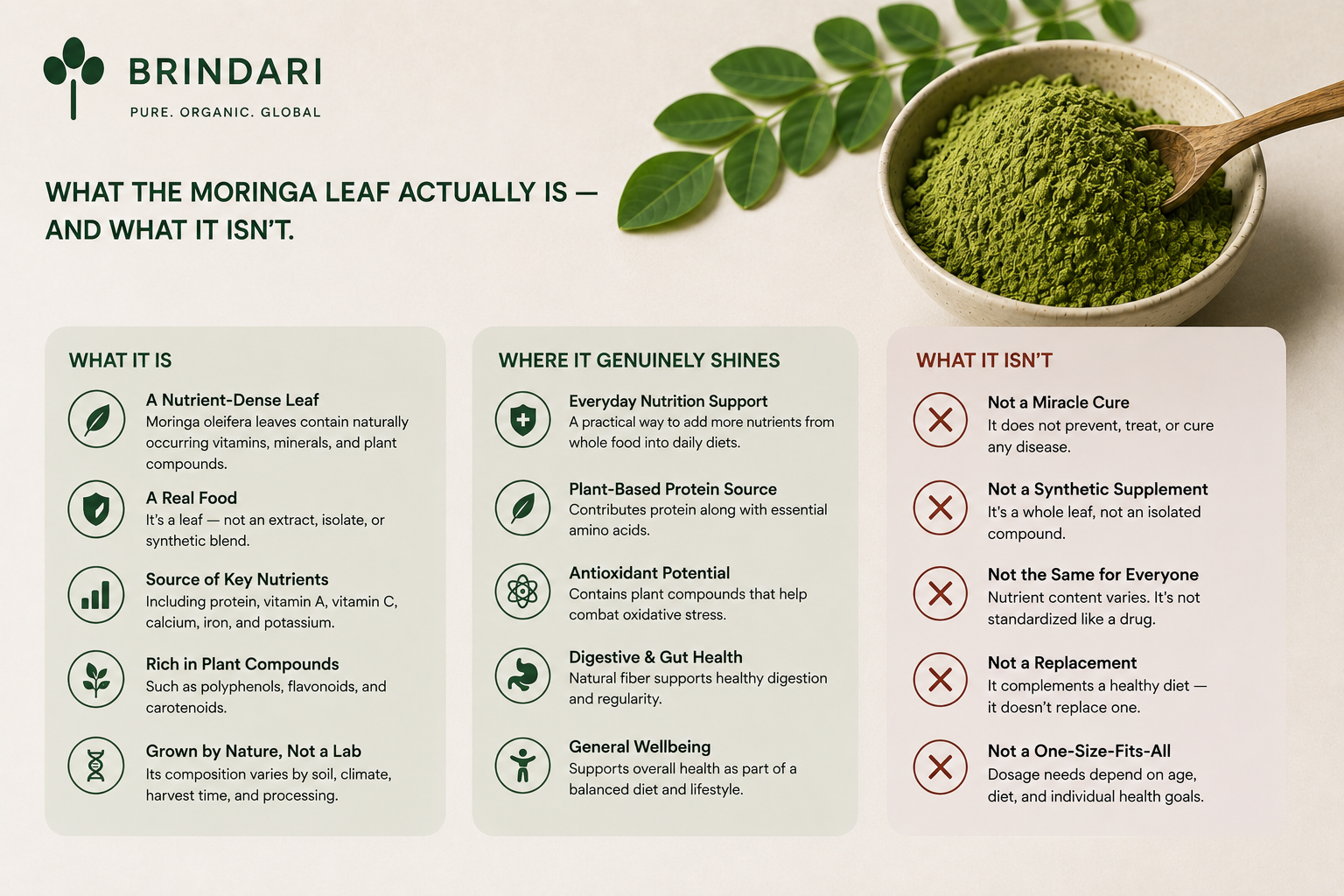
What the leaf is not
- Not a treatment for any disease, full stop. If a label or piece of marketing says it is, that is regulatory exposure for you and false hope for the consumer.
- Not a substitute for a balanced diet. Five grams of any dried plant powder cannot replace a vegetable.
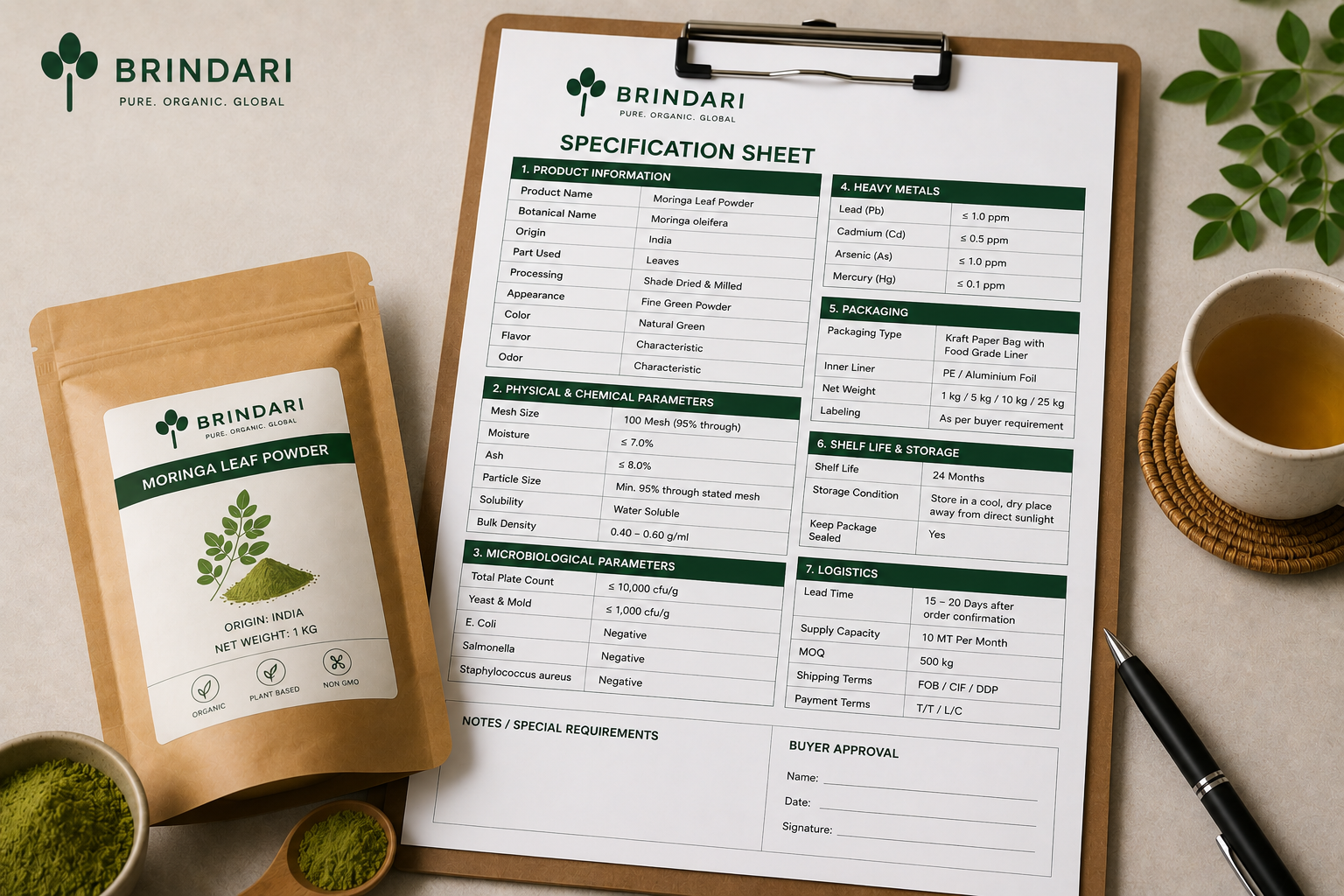
- Not a guaranteed source of any one nutrient. The variability between lots and origins is too wide for that. A specific lot, with a current COA, can be a guaranteed source. The species in general, no.
- Not a "miracle" anything. Plants that solve everything are plants that have been over-marketed.
How to talk about it on a label
Defensible label language is more interesting than hyperbole, and easier to sustain through a regulatory review:
- "A source of iron, calcium, vitamin A, and dietary fibre."
- "Contains naturally occurring antioxidants."
- "Single-origin moringa leaf, shade-dried to preserve colour and active compounds."
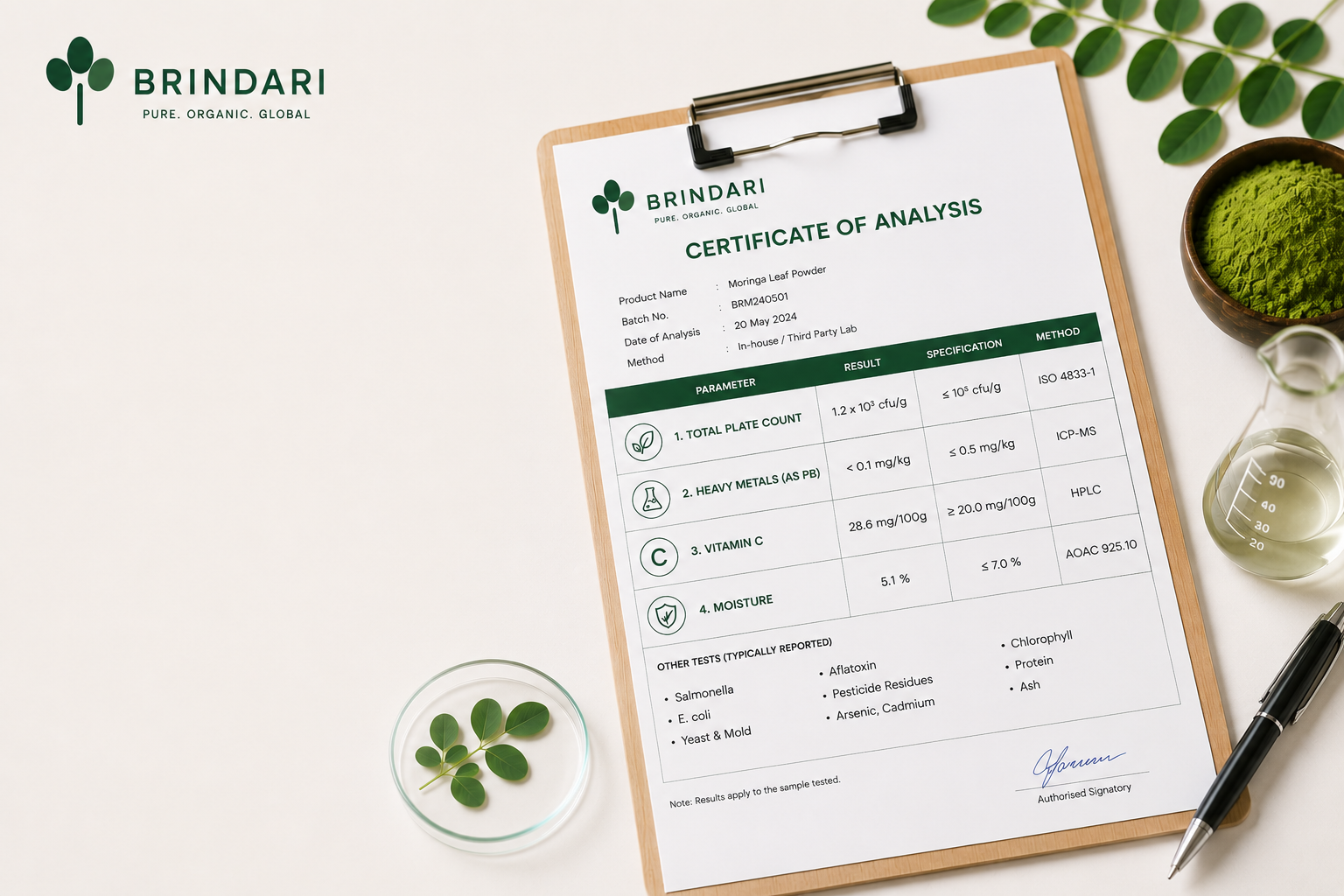
- "Lab-tested for purity. COA available on request."
This is harder copy to write than "the world's most nutrient-dense plant." It is also true, and customers who care about the truth tend to be the customers who repeat-purchase.
Why this matters
Moringa is a useful crop. It is genuinely high in several nutrients. It is genuinely a polyphenol-rich green. It is genuinely worth including in a functional product line — and the category would benefit from broader, more thoughtful use.
What it doesn't need is the over-claiming. Every time a brand calls moringa a miracle, a thoughtful consumer treats the whole category with more scepticism. The honest version of moringa is good enough to sell on its merits. The industry is better off when that's the version on the shelf.